
So many things make March Madness different from anything else in the realm of basketball and college sports. While college football has adopted an expanded bracket format for its playoffs, the playoff only consists of 12 teams playing 11 games. This can hardly compare to the absolute chaos of attempting to watch as many March Madness basketball games as possible, knowing it’s impossible to tune in to all of them.
There is no world in college football playoffs where a team ranked #65 or below has the opportunity to play one of the top 4 teams, and there are many reasons for this. One is that football is much harder on players’ brains and bodies than basketball, and schools don’t want to risk injury by playing too many games per season. Another is that there are far more D1 basketball programs than football programs. The NCAA has 361 D1 basketball teams and 138 D1 football teams, so the former necessitates much bigger playoffs. Thus, smaller schools playing stellar regular seasons (such as Miami of Ohio’s 31-0 run this season) get a chance to compete for a national championship, even when their chances of doing so are slim.
The NBA has nothing close to a single-round elimination format in its playoffs. Every round of playoffs in the NBA, even the first round, has been best of 7 since 2003. Unless your NBA team is 3-3 in a best-of-7 series, every single March Madness game is more high-stakes than any NBA playoff game.
Fan brackets and Cinderella stories are the heart and soul of March Madness. Dedicated fans fill out brackets before the tournament starts, trying to predict who will win which game and advance to the next round. Nobody has ever perfectly predicted the results of March Madness, but that hasn’t stopped millions of diehard fans and bemused casuals from giving it the old college try. It turns March Madness into a legitimate competition for fans, who sometimes care more about their bracket being the most accurate than about any individual team winning. Some fans of the sport think that you should care more about the quality of basketball itself rather than the accuracy of their bracket. However, we think that if fans wanted to watch the best basketball in the world, they would watch the NBA rather than the NCAA.
March Madness Cinderella stories, underdog teams who overcome unbelievable odds to beat heavily-favored opponents, arguably are the most unique element of this tournament. Who could forget in 2018 when 16 seed (aka one of the four lowest-ranked teams after the regular season) University of Maryland, Baltimore County beat 1 seed (one of the four highest-ranked teams after the regular season) Virginia in the first round? UMBC raised a banner for this accomplishment in their gym, as they should, because they were the first 16 seed to ever defeat a 1 seed in March Madness. Mid-major George Mason defeated basketball juggernaut UConn in 2006, advancing to the Final 4, which is by far the most memorable thing George Mason has ever done as an institution. March Madness would be so much less fun if there were never upsets like this, and in the past couple of years, we’ve seen fewer and fewer upsets in March Madness.
There have only been three years in March Madness history when a Mid-Major (which are smaller, less prestigious Division 1 schools, outside of the elite, more competitive “Power” conferences like ACC, Big Ten, Big 12, and SEC) didn’t make the Sweet 16: 1996, 2025, and 2026. There is an obvious culprit behind this, and that’s the emergence of NIL.
NIL stands for Name and Image Likeness, which means a collegiate athlete can use their own name and image to make money. For example, WNBA player Caitlin Clark made bank from Gatorade, Nike, and State Farm commercials before she graduated from the University of Iowa. Before NIL, she wouldn’t have been allowed to do that because the NCAA wanted to distinguish college athletes from professional athletes. Post NIL, those rules have completely gone out the window. It’s not just companies that are paying student athletes to represent their products. Now, the schools themselves are offering huge financial incentives for top talent to commit. The NCAA is basically a semi-professional league at this point.
In an NIL era of college sports, where student-athletes are getting paid millions of dollars to play at the best basketball schools, the chances of a lower-ranked team beating a Power conference team in March Madness have become even less likely than they used to be. The best players at mid-majors rarely stay there for four years, entering the transfer portal after their freshman year, opting to go to bigger, more prestigious schools where they can make a boatload of money and compete for an NCAA championship.
For many basketball fans, the dissolution of Cinderella stories makes them less inclined to tune into the tournament. However, just because the traditional underdogs have been more or less shut out doesn’t mean that the spirit of March Madness or the nail-biting it inspires is gone. It will never be gone until everyone and their mother predicts the exact right bracket every time, which will never happen.
Games between two goliaths, like Duke and UConn, where UConn came back from a 19-point deficit and won with a 3-pointer in the chaotic final seconds, prove that March Madness still has the juice. Basketball fans were confident throughout the entire game that Duke was destined to go to the Final Four. Somehow, through Dan Hurley's insane coaching, an offensive comeback in the second half, and a miracle play by UConn Freshman Braylon Mullins, UConn took down the Blue Devils. UConn, a team that has won 6 NCAA championships and made 8 Final Four appearances in the past 27 years, is hardly a Cinderella, but sometimes underdogs come from the least likely of places. Unexpected victory is at the heart of March Madness, and no amount of money can take that away.
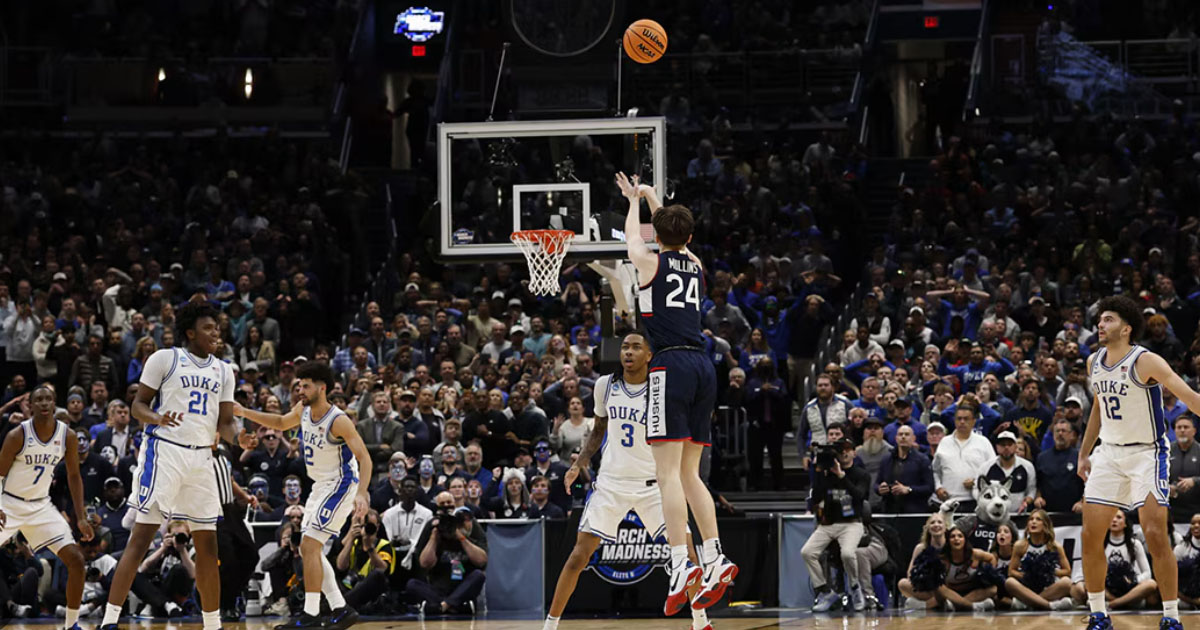
Source: NCAA
Like what you see? Follow Us and Add Us as a Preferred Source on Google.
